
Press brakes and shearing machines are the backbone of any sheet metal workshop, and China is one of the largest producers of both. Buyers can choose from simple hydraulic models for general fabrication to CNC electro-hydraulic and servo-electric press brakes for precise, repeatable bending. Because prices and quality vary widely, it pays to understand what to specify and check before ordering.
This guide covers press brake and shearing machine sourcing from China, including the key specifications, components, tooling and inspection points.
1. Start with your parts and materials
The right machine depends on what you will bend and cut. Prepare this information:
- Materials: mild steel, stainless steel, aluminium or others, with tensile strength where possible.
- Thickness range and maximum sheet length.
- Typical part drawings, including flange lengths, bend radii and box depths.
- Accuracy requirements for angles and dimensions.
- Batch sizes and how often you change setups.
Share drawings with suppliers and ask them to confirm the tonnage, tooling and machine configuration needed, with calculations.
2. Press brake specifications to compare
- Bending force (tonnage) and working length, with a margin for stainless steel and harder materials.
- Throat depth, open height and stroke, which determine the size of boxes and profiles you can form.
- Drive system: torsion-bar hydraulic, electro-hydraulic synchronised (Y1/Y2) or servo-electric.
- Number of CNC axes: Y1, Y2, X, R, Z1, Z2 and V (crowning). More axes increase flexibility for complex parts.
- Crowning system for consistent angles along the full length.
- Back gauge design, speed and accuracy.
- Controller brand, model and programming features such as 2D or 3D graphical programming.
3. Shearing machine specifications to compare
- Type: swing beam or guillotine shear. Guillotine shears generally offer better cut quality and adjustable rake angle.
- Cutting thickness and length for your materials.
- Rake angle and blade clearance adjustment, preferably adjustable through the controller.
- Back gauge range and accuracy, and sheet support system.
- Blade material and number of usable cutting edges.
- Strokes per minute for productivity.
4. Check the key components
Ask suppliers to list the brands of hydraulic systems, valves, seals, servo motors and drives, linear guides, ball screws, electrical components and the CNC controller. Recognised components make spare parts and service easier to find in your country. Compare quotations with the same component specification before comparing prices.
5. Do not forget tooling
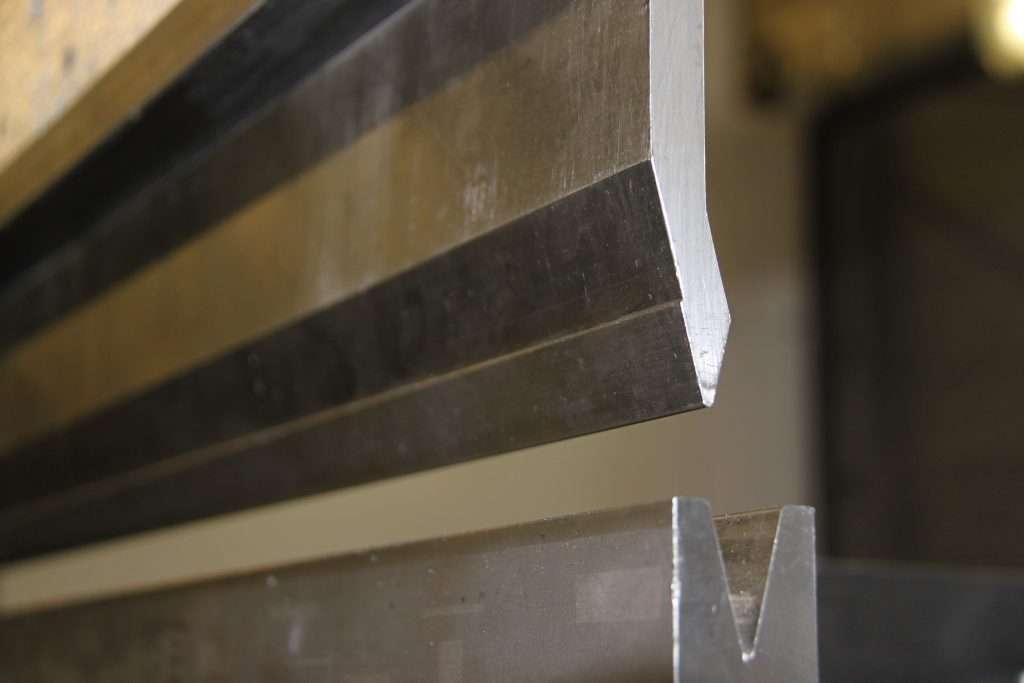
Press brake performance depends heavily on tooling. Clarify which punches and dies are included, their length and segmentation, the tooling standard and clamping system, and whether additional tools for your parts can be supplied. Segmented tooling makes it easier to form boxes and parts with flanges.
6. Safety and compliance
Press brakes and shears are potentially dangerous machines. Specify the safety equipment required in your market, such as light curtains or laser guarding for press brakes, side and rear guards, safety interlocks and foot switches with emergency stops. If you need CE compliance, specify it in the contract and verify the documentation and safety devices during inspection.
7. Inspect and test before shipment
- Bend test pieces of your material and thickness, and measure angles at both ends and in the middle of the bend.
- Check repeatability over several bends and back gauge positioning accuracy.
- Shear test pieces and check cut quality, burr and straightness.
- Run the machine continuously and check for hydraulic leaks, noise and oil temperature.
- Test all safety devices and emergency stops.
- Verify component brands, nameplate data, tooling and spare parts against the contract.
Frequently asked questions
Hydraulic or servo-electric press brake?
Electro-hydraulic CNC press brakes are versatile and widely used across tonnage ranges. Servo-electric models offer high speed, accuracy and energy efficiency, mainly in smaller tonnages. The best choice depends on your parts and budget. For a detailed comparison, including NC torsion-bar machines, see NC vs CNC press brake: how to choose the right type.
Can I buy a press brake and shear together?
Yes. Many Chinese factories make both, and buying them together can simplify shipping and service. You can also combine them with a fiber laser cutting machine for a complete sheet metal workshop.
What spare parts should I order?
Seals, filters, a set of shear blades, back gauge components and key electrical parts are a common starting point. Ask the supplier for a recommended list.
For robotic bending cells and automated sheet metal handling, see our China automation equipment sourcing service.
Source sheet metal machinery with Supbon Sourcing
Supbon Sourcing helps fabricators and distributors source press brakes, shearing machines and laser cutting machines from qualified Chinese manufacturers, with technical comparison, factory audits, test witnessing and shipping. Learn more about our metalworking machinery sourcing service, read our guide to laser equipment sourcing in Jinan, or see how to ship machinery from China.
Equipping a sheet metal workshop? Contact us for a free quote with your materials, thickness and part drawings.