
Short answer: Choose an NC torsion-bar press brake if you bend simple, repetitive parts in mild steel, mostly under about 3 metres long, and your budget is tight. Choose an electro-hydraulic CNC press brake (independent Y1/Y2 control with linear scales) if you need consistent angles across long parts, frequent job changes or multi-step bends. Consider a hybrid servo or all-electric model when energy use, noise and speed matter more than the purchase price.
Chinese factories build every type, from basic torsion-bar machines to multi-axis CNC bending cells, and the price difference between them is large. The problem is that suppliers often describe all of them as “CNC”, and two quotations that look similar on paper can be very different machines. This guide explains the real differences, the specifications that matter, the red flags we see in Chinese quotations, and what to check before the machine leaves the factory. For a broader overview of sheet metal equipment, see our press brake and shearing machine sourcing guide.
The four main press brake types
1. NC torsion-bar press brake
Two hydraulic cylinders move the ram, and a heavy steel torsion bar mechanically ties the two sides together so they stay roughly parallel. A simple NC controller positions the back gauge (X axis) and the ram stop depth (Y axis), often through a motorised stop. These machines are rugged, easy to maintain and the cheapest to buy. Their weakness is accuracy: the torsion bar can twist under off-centre loads, the ram cannot be tilted to correct for uneven bends, and angle consistency on long parts depends heavily on operator skill and manual crowning adjustment.
2. Electro-hydraulic synchronised CNC press brake
Each cylinder is controlled independently by a proportional servo valve system, and linear scales (often called “grating rulers” by Chinese suppliers) mounted on the side frames feed back the real ram position on both sides. The CNC controller closes the loop on Y1 and Y2, so the ram stays parallel even with off-centre bends, and the operator can tilt it deliberately when needed. This is the mainstream choice for job shops and fabricators because it combines accuracy, tonnage range and reasonable cost. Typical options include a multi-axis back gauge (X, R, Z1, Z2 and sometimes X1/X2), CNC crowning, and graphical 2D or 3D controllers with bend-sequence programming.
3. Hybrid servo (servo-pump) press brake
The hydraulic system remains, but the pump is driven by a servo motor that runs only when the ram moves, instead of a constant-speed motor running all day. Suppliers usually promote lower energy consumption, less oil heating and lower noise. Real savings depend on your duty cycle, so ask the supplier to explain how their figures were measured rather than accepting a headline percentage.
4. All-electric servo press brake
The ram is driven by servo motors through ball screws or belt-and-pulley systems, with no hydraulic oil at all. These machines are fast, quiet and very repeatable, and they suit small precise parts such as electrical enclosures and electronics brackets. They are typically built in smaller tonnages and shorter lengths, and the purchase price per tonne is usually higher than for hydraulic machines.
Comparison table: which type fits your work?
| Factor | NC torsion-bar | Electro-hydraulic CNC | Hybrid servo | All-electric |
|---|---|---|---|---|
| Ram synchronisation | Mechanical torsion bar | Independent Y1/Y2 with linear scales | Independent Y1/Y2 with linear scales | Servo motors, direct position control |
| Angle consistency on long parts | Fair, operator-dependent | Good to very good | Good to very good | Very good |
| Typical tonnage range | Small to medium | Very wide, small to very large | Small to large | Mostly small |
| Set-up time between jobs | Longer | Short with programs stored | Short | Short |
| Energy use and noise | Pump runs continuously | Pump runs continuously | Lower | Lowest |
| Maintenance | Simple | Hydraulics plus electronics | Hydraulics plus servo drive | No oil; screws, belts and drives |
| Relative purchase price | Lowest | Medium | Medium to high | Highest per tonne |
| Best for | Simple repetitive bends, training, budget shops | Job shops, fabricators, most buyers | High-use shops focused on running cost | Small precise parts, clean environments |
How to size tonnage and bending length
Start from your thickest, longest and hardest part, not from a catalogue. For air bending, a widely used estimate is: required force (kN per metre) ≈ 1.42 × tensile strength (MPa) × thickness² (mm) ÷ V-die opening (mm). With mild steel around 450 MPa, 3 mm thick, on a 24 mm V-die (eight times the thickness), that gives roughly 240 kN per metre, or about 24 tonnes per metre. Stainless steel typically needs around 1.5 times as much force as mild steel, and soft aluminium about half. Always ask the supplier to confirm the calculation with the V-die they will actually supply, because tonnage drops sharply as the V-opening widens and rises sharply as it narrows.
Add a safety margin, often 20 to 30 percent, and remember that you will rarely bend the full length at full thickness. A 100-tonne, 3.2-metre machine (often called “100T/3200” in Chinese quotations) is a common general-purpose size, but the right size is the one your parts justify.
Specifications that matter in a Chinese quotation
- Controller model and axes. Ask for the exact controller model and the list of controlled axes. “CNC” alone means nothing. A 2-axis NC controller and a 6+1-axis graphical CNC controller are very different machines.
- Synchronisation method. Torsion bar or electro-hydraulic with linear scales. Ask for photos of the scales mounted on the frames.
- Hydraulic system. Brand and type of the valve block, pump and seals. Confirm whether the valve block is an integrated proportional system or a lower-cost alternative.
- Crowning. Manual wedge, motorised CNC wedge or hydraulic crowning. For long parts this has a large effect on angle consistency from end to end.
- Back gauge. Number of axes, travel, drive type (servo motor with ball screw and linear guide versus stepper or AC motor with simpler drives) and finger design.
- Frame. Side plate and table thickness, welding method and stress relief. Many reputable factories use annealing or vibration ageing after welding; ask which they use and request photos.
- Open height, stroke and throat depth. These decide whether deep boxes and channels can be bent and removed. Check them against your deepest part.
- Speeds. Approach, working and return speeds affect output. Compare like with like, since suppliers sometimes quote maximum values that are not used in practice.
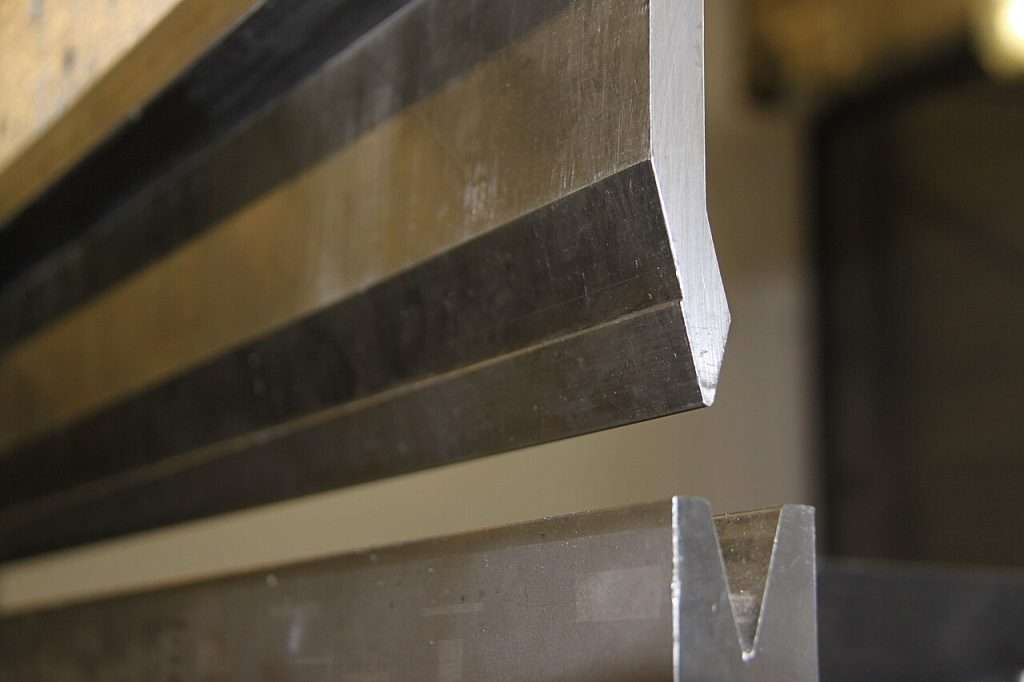
- Tooling. Punch and die profiles, material and hardness, segmented lengths and clamping system (manual, quick-release or hydraulic).
- Safety. Front laser guarding or light curtains, rear guarding, foot pedal with emergency stop and a safety-rated control circuit as required in your market. See our CE marking guide for machinery from China.
- Electrical supply. Voltage, frequency and control voltage must match your workshop.
Common mistakes and red flags with Chinese suppliers
- NC sold as CNC. A torsion-bar machine with a simple controller is sometimes listed as “CNC press brake”. If there are no linear scales and no independent Y1/Y2 control, it is an NC machine, whatever the title says.
- Controller lookalikes or old versions. A well-known controller name in the quotation does not guarantee the current genuine model. Ask for the exact model, software version and a photo of the controller’s nameplate.
- Tonnage quoted at a different V-die. Two suppliers may quote the same capacity but assume different dies. Ask both to state the thickness, material and V-opening for the rated capacity.
- Component substitution. The proposal lists one brand of valves, servo motors or guides, and the delivered machine uses another. Put the component list in the purchase contract and check it at inspection.
- Thin frames to win on price. Lighter side plates and tables reduce cost but increase deflection. Compare machine weights for the same tonnage and length; a much lighter machine deserves questions.
- Tooling treated as an afterthought. A low price may include only one basic punch and a single multi-V die. Specify the tooling you need for your parts.
- No safety system for your market. Many domestic-market machines ship with minimal guarding. Retrofitting later is expensive and slow.
Pre-shipment inspection checklist
Test the machine in the factory with your own drawings and, ideally, your own material. Our factory acceptance test guide explains how to structure the test.
| Check | What to look for | How to verify |
|---|---|---|
| Component list | Controller, valves, pump, motors, guides and scales match the contract | Nameplates and photos of each major component |
| Ram parallelism and repeatability | Y1/Y2 positions stable on repeated cycles | Dial indicator readings at both ends over several strokes |
| Angle consistency | Same angle at left, centre and right of a long bend | Bend a full-length test piece and measure with a protractor or angle gauge at several points |
| Crowning effect | Crowning corrects the centre angle | Compare long bends with crowning off and on |
| Back gauge accuracy | Flange lengths match the program | Measure flanges on test parts; check R and Z axes move smoothly |
| Hydraulic system | No leaks, stable pressure, acceptable oil temperature | Run continuously for an extended period and inspect all fittings |
| Safety functions | Guarding, emergency stops and pedal work as specified | Test every stop and safety device in front of the inspector |
| Tooling | Profiles, lengths and hardness as ordered | Count segments, check markings and test-bend with each tool |
| Documents | English manual, hydraulic and electrical diagrams, controller manual | Review files before shipment, not after arrival |
Shipping, installation and spare parts
Most small and medium press brakes fit in a 20ft or 40ft container, while large or long machines may need an open-top or flat-rack container. The machine should be bolted to a skid, the ram lowered onto blocks, exposed steel surfaces coated with anti-rust oil, the controller protected against moisture, and the hydraulic oil normally drained or handled according to the forwarder’s rules. See our export packing and container loading guide.
On arrival you will need a forklift or crane with enough capacity, a level concrete floor, the correct power supply and hydraulic oil of the grade the supplier specifies. Many Chinese suppliers offer remote video commissioning; on-site engineer visits are usually possible but at extra cost, so confirm terms in advance. Order a starter kit of spare parts with the machine: seals, filters, a spare foot pedal, back gauge fingers and key electrical parts are a common starting point. Our spare parts guide explains how to build the list.
Frequently asked questions
Is an NC torsion-bar press brake good enough?
For simple bends in mild steel on shorter parts, often yes, and it is the cheapest option. If you bend long parts, stainless steel, or many different jobs per day, an electro-hydraulic CNC machine usually pays back through less scrap and faster set-up.
How do I tell NC from CNC in a quotation?
Look for independent Y1/Y2 control, linear scales on both side frames and a controller that closes the loop on ram position. If the quotation mentions a torsion bar, it is an NC machine.
What tonnage do I need?
Calculate from your thickest and hardest part using the V-die you will actually use, then add a margin of around 20 to 30 percent. Ask the supplier to confirm the calculation in writing.
Is a servo or electric press brake worth the extra cost?
It depends on how many hours the machine runs and what you pay for electricity. High-use shops bending smaller parts often benefit most. Ask suppliers for measured energy data under a realistic duty cycle.
Can I buy a press brake together with a laser cutter?
Yes. Many buyers combine a fiber laser cutting machine and a press brake in one shipment. See our laser cutting machine sourcing guide.
Source press brakes with Supbon Sourcing
Supbon Sourcing helps fabricators, distributors and factories compare Chinese press brake manufacturers, check controller and component specifications, witness bending tests and arrange export packing and shipping. Learn more about our metalworking machinery sourcing service and our sourcing agent fees. To get started, contact us with your part drawings, materials, thickness and bending length.