
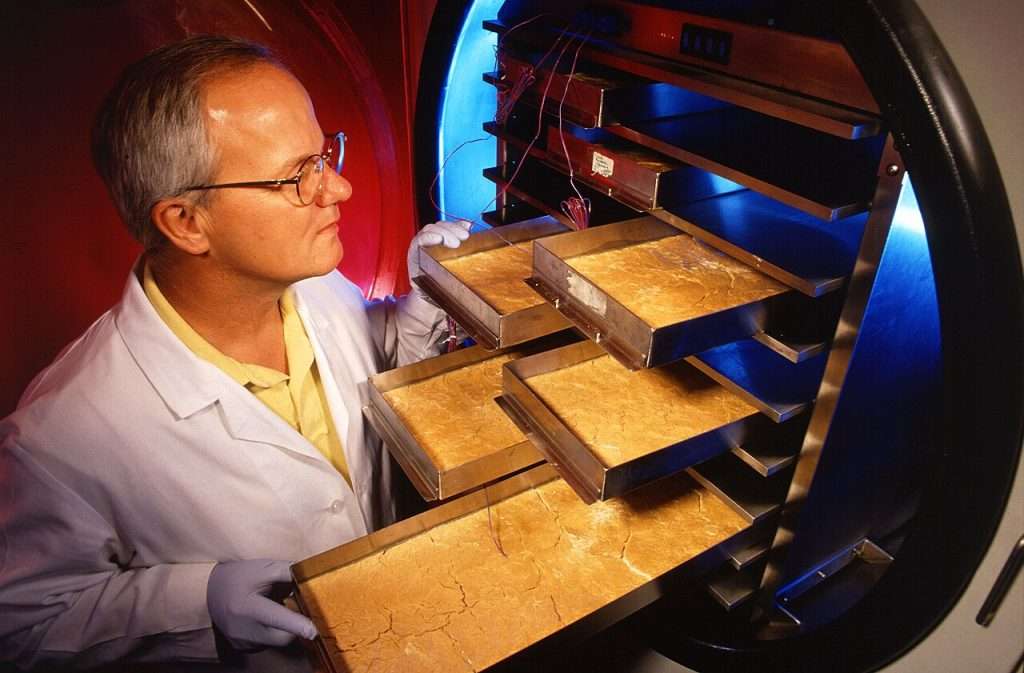
Dried fruit, vegetables, herbs, instant foods and pet treats are growing product categories, and the drying step usually decides both quality and running cost. Chinese manufacturers build a broad range of equipment, from small tray dryers to large vacuum freeze-drying plants. Published specifications are not always comparable, however, particularly on freeze dryers, where a nominal capacity can hide a slow cycle. This guide shows buyers how to specify and check food drying equipment from China.
Types of food drying equipment
- Vacuum freeze dryers: ice is removed by sublimation under vacuum. They preserve shape and flavour well but have higher capital and energy costs.
- Hot-air tray and cabinet dryers: simple batch machines suited to small and medium volumes.
- Mesh belt dryers: continuous multi-layer lines for vegetables, fruit, nuts and herbs.
- Heat pump dryers: closed-loop units that can reduce energy use in suitable climates and products.
- Spray dryers: used to turn liquids such as milk, coffee or extracts into powder.
- Microwave and vacuum microwave dryers: faster drying for selected products, requiring careful control and safety design.
- Fluidized bed dryers: used for granules and small free-flowing pieces.
What to specify before asking for quotes
A strong RFQ for drying equipment describes the product, not only the machine:
- Product, piece size, loading thickness and initial moisture.
- Target final moisture or water activity.
- Output needed per day, expressed as wet input and dry output.
- For freeze dryers: tray area, ice capacity, target cycle time and condenser temperature.
- Heat source available: electricity, steam, gas or hot water.
- Site climate, power supply and available cooling water.
- Automation, recipe storage and data logging needs.
- Food safety requirements of your destination market.
Ideally, send a sample of your product to the supplier for a trial. Moisture curves on real material tell you far more than a catalogue number.
Key quality points
- Vacuum system: on freeze dryers, check pump type and brand, the ultimate vacuum reached and how fast the chamber pumps down.
- Refrigeration system: compressor brand, refrigerant type and the condenser temperature reached under load. Undersized cooling is a common weakness.
- Shelf heating: temperature uniformity across shelves affects product consistency. Ask for measured data rather than a setpoint figure.
- Chamber and door sealing: check welds, gaskets and leak rate.
- Airflow on hot-air dryers: uneven airflow leads to wet spots and burnt edges. Ask how air is distributed and reversed.
- Food-contact parts: trays, belts and interior surfaces should be suitable for food and easy to clean, usually stainless steel, with material documents available.
- Controls: PLC brand, recipe control, alarm history and English-language interface.
Safety and compliance
Requirements depend on your market, so confirm them before ordering. Machinery for Europe normally needs CE marking, and some vacuum or pressure vessels may raise further questions. Refrigerants are regulated in many regions, including under EU F-gas rules, so tell the supplier which refrigerants are permitted where you operate. Food-contact materials need suitable declarations. Heaters, microwave systems and gas burners all have their own electrical and safety considerations, so involve a local engineer.
Estimating real running cost
The purchase price is only part of the decision, particularly for freeze drying, where electricity and maintenance continue for years. Before you compare offers, ask each supplier for:
- Expected energy use per batch or per kilogram of water removed, on a stated product.
- Actual cycle length, including loading, defrosting and cleaning time.
- Vacuum pump oil and filter service intervals.
- Labour needed for loading, unloading and tray cleaning.
Treat these as estimates, and check them during your trial batch wherever possible.
Testing before shipment
A meaningful factory acceptance test should prove performance as far as possible:
- Empty-chamber pump-down test, recording time and final vacuum.
- Vacuum leak-rate test.
- Condenser cool-down test, recording time and lowest temperature.
- Shelf or air temperature mapping at several points.
- A trial batch with your product or a close substitute, recording cycle time and final moisture.
- Check of alarms, power-failure behaviour, emergency stops and data records.
- Inspection against the agreed specification and component list, supported by staged quality inspection.
Shipping and spares
Large freeze dryers can be heavy and awkward, and some ship as split modules that need refrigeration work at site. Agree the transport dimensions, lifting points and any reassembly work early, and consult our guide to shipping machinery from China. Stock door seals, vacuum pump oil and filters, belts, sensors, fan bearings and any wear parts recommended by the supplier. Plan for trained refrigeration technicians locally, since these systems will need routine servicing. Our article on warranty and after-sales service covers what to agree in advance.
Frequently asked questions
How do I compare freeze dryer capacity between suppliers?
Compare tray area, ice capacity per batch and proven cycle time on a similar product. A machine with a higher nominal capacity may run longer cycles and produce less per week.
Is freeze drying better than hot-air drying?
It generally retains shape, colour and flavour better, but costs more to buy and run. For many vegetables, herbs and low-priced products, a well-designed hot-air or heat pump dryer may be the better business decision.
Can a trial be done before I buy?
Many manufacturers can arrange a trial if you send product samples, sometimes for a fee. Check import rules for sending food samples, and agree the trial conditions and how results will be reported.
Source food drying equipment with Supbon Sourcing
Supbon Sourcing is based in Jinan, Shandong and helps overseas buyers find suitable manufacturers, compare technical offers and check equipment before shipment. If drying is one stage of a larger plant, you may also want to read about fruit and vegetable processing lines. Contact us with your product, moisture targets and daily output.