
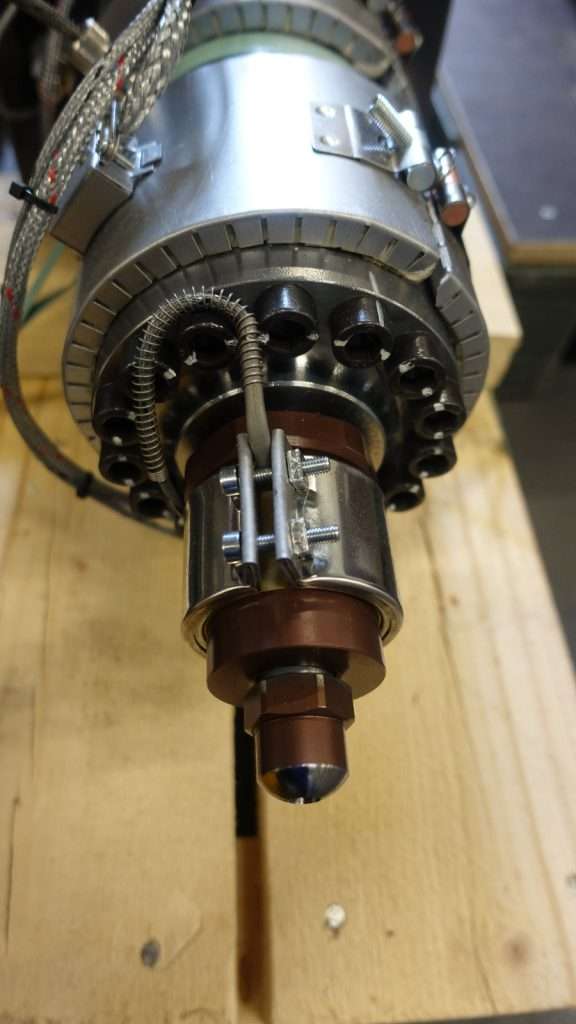
Short answer: size an injection molding machine from the mold, not from the catalogue. Clamping force is usually estimated as the projected area of all cavities and runners multiplied by a material factor, plus a 10–20% margin; the shot volume should typically fall between about 20% and 80% of the barrel’s capacity; and the mold must physically fit the tie-bar spacing, mold height range and opening stroke. Get these three checks right and most Chinese machines in the correct class will run your part well.
This guide is written for importers, molders and product companies buying an injection molding machine from China for a specific mold or product family. It explains how to calculate tonnage and shot size, which specifications on a Chinese quotation actually matter, where suppliers make the numbers look better than they are, and what to test before the machine leaves the factory. For a broader overview of the market, see our injection molding machine sourcing guide.
Step 1: Calculate the clamping force you need
During injection, melt pressure inside the cavity tries to push the mold halves apart. The clamp must hold them closed, or the part will flash. A practical estimate is:
Clamping force (tonnes) = projected area (cm²) × clamping factor (t/cm²) × safety margin
- Projected area is the area of the part as seen from the direction the mold opens, not the surface area. Add every cavity and the runner system (for cold runners). Holes through the part can be subtracted.
- Clamping factor depends on the resin, wall thickness and flow length. For many common materials, molders use roughly 2–5 tons per square inch (about 0.3–0.8 t/cm²). Easy-flow resins such as PP or PE with normal walls sit at the low end. Thin-wall parts, long flow paths and engineering resins such as PC, PA with glass fibre or POM often need the high end or more.
- Safety margin of 10–20% covers process variation and the fact that a machine running constantly at 100% of its rated clamp will wear faster.
Example: a 4-cavity PP lid, each cavity 120 cm² projected, plus 30 cm² of runner, gives 510 cm². At 0.35 t/cm² that is about 179 t; with a 15% margin, around 205 t. A 200–250 t machine would be the starting point, and the final choice would then depend on the mold size checks below.
If your mold maker or resin supplier has run a mold-flow simulation, use its predicted clamp force instead of the rule of thumb. It is usually more accurate.
Step 2: Check shot size and screw selection
Shot size is the volume or weight of plastic injected per cycle, including runners. The machine’s barrel capacity must comfortably cover it.
- Keep the shot in the middle of the range. A common guideline is to use between about 20% and 80% of the barrel’s maximum shot. Below that, the melt stays in the barrel too long and heat-sensitive resins such as PVC or POM may degrade. Above that, there is not enough cushion and plasticising capacity for a stable process.
- Convert the rated shot weight. Chinese catalogues usually state the theoretical shot weight in grams of PS (polystyrene, density about 1.05). For PP (about 0.9) the real shot weight is lower. Always ask whether the figure is theoretical volume (cm³) or PS weight.
- Screw A, B or C. Most Chinese manufacturers offer two or three screw diameters for the same clamp unit. A smaller screw gives higher injection pressure but less shot volume; a larger screw gives more volume but lower pressure. Choose the screw for your part: thin-wall packaging needs pressure and speed; thick technical parts need volume.
- L/D ratio and screw type. General-purpose screws are often around 20:1 to 24:1. PVC, PET, glass-filled nylon or PC may need a special screw, barrel coating or check ring. Say which resin you will run in your RFQ.
Step 3: Make sure the mold fits the machine
Many buyers calculate tonnage correctly and then find that the mold does not fit. Check these dimensions against the mold drawing:
- Tie-bar spacing (horizontal × vertical): the mold must pass between the tie bars when loaded, or at least fit the platen if it is loaded from the side. Wide molds sometimes force you into a larger tonnage class, or a machine with wider tie-bar spacing.
- Mold height (min–max): the mold’s shut height must fall within the machine’s range.
- Opening stroke and daylight: the mold must open far enough to eject the part and runner. For deep parts such as buckets or crates, a common rough check is at least twice the part depth plus the runner, but confirm with your mold maker.
- Ejector stroke and force, plus the number and position of ejector holes.
- Locating ring diameter, nozzle radius and platen hole pattern, so the existing mold mounts without adapters.
- Core pulls, hot runner zones and valve gates: count how many hydraulic core-pull circuits, hot runner temperature zones and sequential valve gate outputs you need.
Step 4: Choose the machine type
Most Chinese suppliers offer several drive concepts. The table below gives a general comparison; actual performance depends on the specific model and supplier.
| Type | Typical use | Strengths | Watch out for |
|---|---|---|---|
| Servo-hydraulic, toggle clamp | Most general molding, roughly 50–1000 t | Good value, much lower energy use than old fixed-pump machines, wide choice of suppliers | Servo motor and drive quality vary; check the hydraulic components and oil cooling |
| All-electric | Precision parts, medical, electronics, clean environments | High repeatability, lower energy, quiet, no hydraulic oil | Higher price; ball screws and servo drives are wear parts; tonnage range is usually smaller |
| Two-platen hydraulic | Large parts: bins, pallets, automotive, often 800 t and above | Shorter machine footprint, large mold space, even clamp force | Complex hydraulics; installation and commissioning support are important |
| Hybrid (electric injection, hydraulic clamp) | Thin-wall packaging, fast cycles | High injection speed with robust clamp | Fewer suppliers; confirm the real injection speed in a test |
| Vertical machine | Insert molding, overmolding cables and metal parts | Easy insert loading, rotary table options | Lower output per machine; check the table indexing accuracy |
Other specifications that matter on a Chinese quotation
- Injection pressure and speed: thin-wall parts need high injection speed (mm/s or cm³/s). Ask for both values for the screw you choose.
- Plasticising rate (g/s): must keep up with your cycle time. A large shot on a short cycle can be limited by recovery, not by clamp.
- Controller: check the language, the number of stored mold programmes, the process monitoring and the interface for robots or MES systems.
- Electrical supply: voltage, frequency and total connected load. Heater bands, servo drive and motors must match your grid. See our guide on voltage and frequency for imported machinery.
- Auxiliaries: dryer, hopper loader, mold temperature controller, chiller and robot. A chiller is often sized from the machine’s oil cooling and the mold’s heat load; see industrial chiller sourcing.
- Safety and compliance: safety gates with interlocks, emergency stops, and the documents your market requires. For the EU, CE marking is the importer’s concern too.
Common mistakes and red flags with Chinese suppliers
- Mixing screw A, B and C figures. A quotation may show the highest pressure from screw A and the largest shot from screw C, as if one screw gave both. Ask for a full data sheet for the exact screw you are buying.
- Shot weight in PS without saying so. Your PP or PE part will weigh less per cycle than the catalogue figure suggests.
- “Nominal” tonnage. Ask how the clamping force is verified. A load cell or clamp force sensor test at FAT is a reasonable request.
- Vague component lists. “Imported servo” or “famous brand hydraulics” means little. Ask for brand and model of the servo motor, drive, pump, main valves, controller and screw/barrel material, and write them into the contract.
- Undersized tie-bar spacing. A machine that looks cheaper may simply be too small for your mold.
- No test with your mold or resin. A test with the supplier’s demo mold proves the machine runs, not that it runs your part.
- Prices far below other quotes. Compare the same screw, the same configuration and the same auxiliaries before deciding. Our guide to comparing machinery quotations explains how.
What to inspect and test before shipment
Ideally, send your mold (or a sample mold) and resin to the factory for the acceptance test. If that is not possible, test with a mold of similar size and the closest resin. A checklist:
| Check | How | What good looks like |
|---|---|---|
| Configuration vs contract | Compare nameplates, screw diameter, components and controller with the contract | Every item matches the agreed brand, model and size |
| Mold fit | Measure tie-bar spacing, mold height range, opening stroke and ejector pattern | Your mold mounts without modification |
| Dry cycle | Run open/close and eject cycles without injection | Smooth, quiet movement, dry cycle time near the data sheet value |
| Clamp force | Clamp force sensor or tie-bar strain measurement, if the factory has one | Close to the rated value at full clamp |
| Production run | Run your mold and resin for a continuous period, for example several hours | Stable cycle, no flash or short shots, consistent part weight |
| Shot weight consistency | Weigh a series of parts or shots | Low variation; agree the tolerance in advance |
| Temperatures | Check barrel zones, oil temperature after a long run | Zones stable; oil temperature within the supplier’s stated range |
| Hydraulics and leaks | Inspect hoses, fittings and the area under the machine after the run | No oil leaks |
| Safety | Test gate interlocks, emergency stops and guards | Every safety device stops the machine |
| Documents and spares | Check manuals, electrical and hydraulic diagrams, spare parts list | Complete, in English, matching the machine |
For a full procedure, see our factory acceptance test guide.
Shipping, installation and spare parts
- Shipping: small and mid-size machines often fit in a 40ft container or open-top container; large machines may be split or shipped as breakbulk or on flat racks. Confirm the shipping weight and dimensions early. See export packing and container loading.
- Packing: the hydraulic oil is usually drained, the clamp locked, the machine wrapped against moisture and fixed to a skid. Control cabinets should be protected from condensation.
- Installation: prepare a level foundation, power supply, cooling water and compressed air before the machine arrives. Agree whether a technician will come, who pays for travel, and how long commissioning will take. Remote video support is an option for simpler machines.
- Spare parts: a typical starter kit includes heater bands, thermocouples, seals, a check ring set, nozzle tip, filters and key electrical parts. Ask for a priced spare parts list for one to two years of operation.
- Warranty: confirm what is covered, how long, and how parts are shipped under warranty. Typical warranties cover the main machine for a limited period, but terms vary by supplier.
Frequently asked questions
How do I calculate injection molding machine tonnage?
Multiply the total projected area of all cavities and runners (in cm²) by a clamping factor for your resin, often about 0.3–0.8 t/cm², then add 10–20% margin. Use mold-flow results if available, and confirm with your mold maker.
Is a bigger machine safer?
Not always. An oversized machine costs more, uses more energy and may give a shot below 20% of barrel capacity, which can degrade the resin. The best machine fits your mold and puts the shot in the middle of the barrel’s range.
Should I choose servo-hydraulic or all-electric?
For most general parts, a servo-hydraulic machine offers good value. All-electric machines suit precision, medical or clean-room work where repeatability and cleanliness justify the higher price.
Can the Chinese supplier test my mold before shipment?
Usually yes, if you ship the mold to the factory or the mold is made in China. Agree the test conditions, resin, run time and acceptance criteria in the contract.
What information should I send for a quotation?
Send the part drawings or 3D files, resin, number of cavities, mold dimensions and weight, target cycle time, hot runner zones, core pulls, power supply and the auxiliaries you need. Our guide on writing a machinery RFQ has a template.
Source injection molding machines with Supbon Sourcing
Supbon Sourcing helps buyers turn a mold and a part drawing into the right machine specification, compare Chinese manufacturers on the same configuration, test machines with your mold or a similar one, and handle inspection and shipping. Learn more about our injection molding machine sourcing service, or see our service fees.
Have a mold or part to produce? Send us your part drawings, resin and output target and we will help you size the machine.