
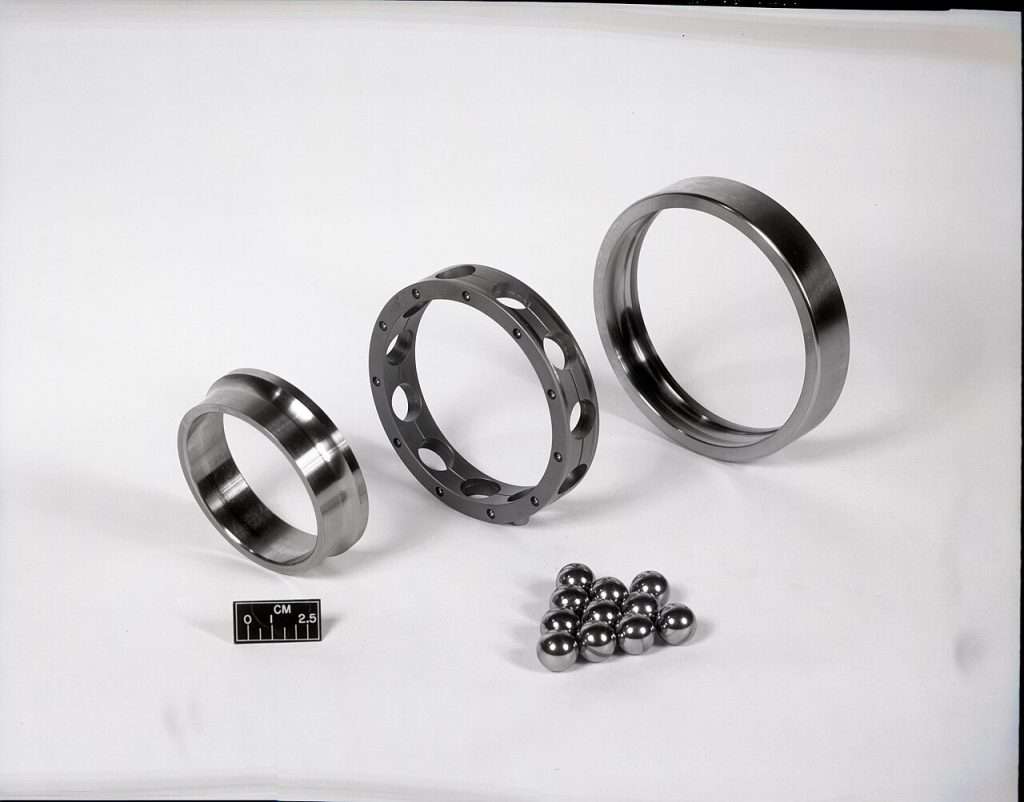
Bearings are in almost every machine: motors, gearboxes, pumps, conveyors, agricultural equipment, vehicles and machine tools. China produces bearings in very large volumes, from low-cost general-purpose ball bearings to precision bearings for machine spindles. Shandong province has well-known bearing clusters, in particular around Linqing in Liaocheng, where many manufacturers and traders operate. For importers and distributors, the opportunity is real, but so are the risks: quality varies widely, and counterfeit branded bearings are a known problem in the market.
Common bearing types
- Deep groove ball bearings: the most common type, used in electric motors, fans, pumps and household appliances.
- Angular contact ball bearings: for combined radial and axial loads, such as pumps and machine spindles.
- Tapered roller bearings: for wheel hubs, gearboxes, trailers and agricultural machinery.
- Cylindrical and spherical roller bearings: for heavy radial loads in crushers, vibrating screens, conveyors and gearboxes.
- Thrust bearings: for axial loads.
- Pillow block and flange units (mounted bearings): housing plus insert bearing, widely used on conveyors and farm machinery.
- Needle bearings and special bearings: for compact designs and specific applications such as slewing rings for cranes and excavators.
What to specify
- Bearing designation according to ISO dimension series, plus inner diameter, outer diameter and width.
- Precision class (for example normal/P0, P6, P5) and internal clearance (C2, CN, C3, C4).
- Seal or shield type: open, metal shield (ZZ), rubber seal (2RS), and the seal material.
- Cage material: pressed steel, brass, or polyamide.
- Steel grade, commonly high-carbon chrome bearing steel (GCr15, similar to 52100), and heat treatment.
- Grease type and fill, plus any special operating temperature or speed.
- Packing: single box, tube, industrial packing, and your own brand if needed. See our article on OEM and private label.
For a structured request, use our RFQ and technical specification guide.
Key quality points
- Dimensional accuracy: bore, outer diameter and width tolerance, plus radial runout.
- Noise and vibration: good suppliers test vibration levels on each bearing; ask about the test method and grades.
- Hardness: rings and rolling elements should be within the expected hardness range after heat treatment.
- Surface finish: raceways should be smooth with no grinding marks, rust or pitting.
- Clearance: verify that internal clearance matches the order (C3 bearings are often specified for electric motors).
- Consistency: check several bearings from each lot, not just one sample.
Counterfeit and branding risks
- Do not buy goods marked with a global bearing brand unless they come through that brand’s authorized channels. Counterfeit branded bearings exist and can create legal problems at customs as well as quality failures.
- If you need unbranded or your own brand, say so clearly in the contract and on the packing instructions.
- Verify the supplier is a real manufacturer or a capable trader before paying. See how to verify a Chinese supplier.
Compliance and documents
- Ask for material certificates, heat treatment records and test reports for each lot.
- Check REACH or RoHS requirements for greases, seals and coatings if you sell into the EU.
- Country-of-origin marking on packaging may be required in your market.
- Check anti-dumping or special duties on bearings in your destination market before ordering; rules differ by country and product.
Testing before shipment
A pre-shipment inspection for bearings normally includes:
- Sampling according to an agreed AQL level.
- Dimensional checks with calibrated gauges.
- Rotation feel and noise check, and vibration testing if equipment is available.
- Hardness checks on sample rings.
- Visual checks for rust, damage, seal fit and marking.
- Packing checks: anti-rust oil or VCI paper, carton strength and labels.
Shipping and storage
- Bearings are heavy for their size; plan pallet weight and container loading limits.
- Protect against moisture: anti-rust treatment, sealed bags, desiccant and good palletizing. See shipping from China.
- Store in a dry warehouse and rotate stock, because grease and anti-rust protection age over time.
- Production lead times for standard sizes are often a few weeks; special sizes take longer. Confirm with the supplier.
Frequently asked questions
Are Chinese bearings good quality?
Quality ranges from very low to very good. Leading Chinese manufacturers produce bearings for demanding industrial uses, while some small workshops sell inconsistent products. Testing and factory checks are the way to tell the difference.
What is the minimum order quantity?
It depends on the size and the supplier. Common sizes may be available from stock in small quantities, while special sizes or your own brand usually need a larger order. Ask each supplier.
Can I order bearings together with other parts?
Yes. Many buyers combine bearings with fasteners, motors and other components in one container to reduce freight cost per unit.
Source industrial bearings with Supbon Sourcing
Supbon Sourcing is based in Jinan, Shandong, within reach of the province’s bearing and machinery suppliers. We help importers and distributors find manufacturers, compare quotations, check samples and inspect goods before shipment. See our custom industrial equipment sourcing service, or contact us with your bearing list and quantities.