
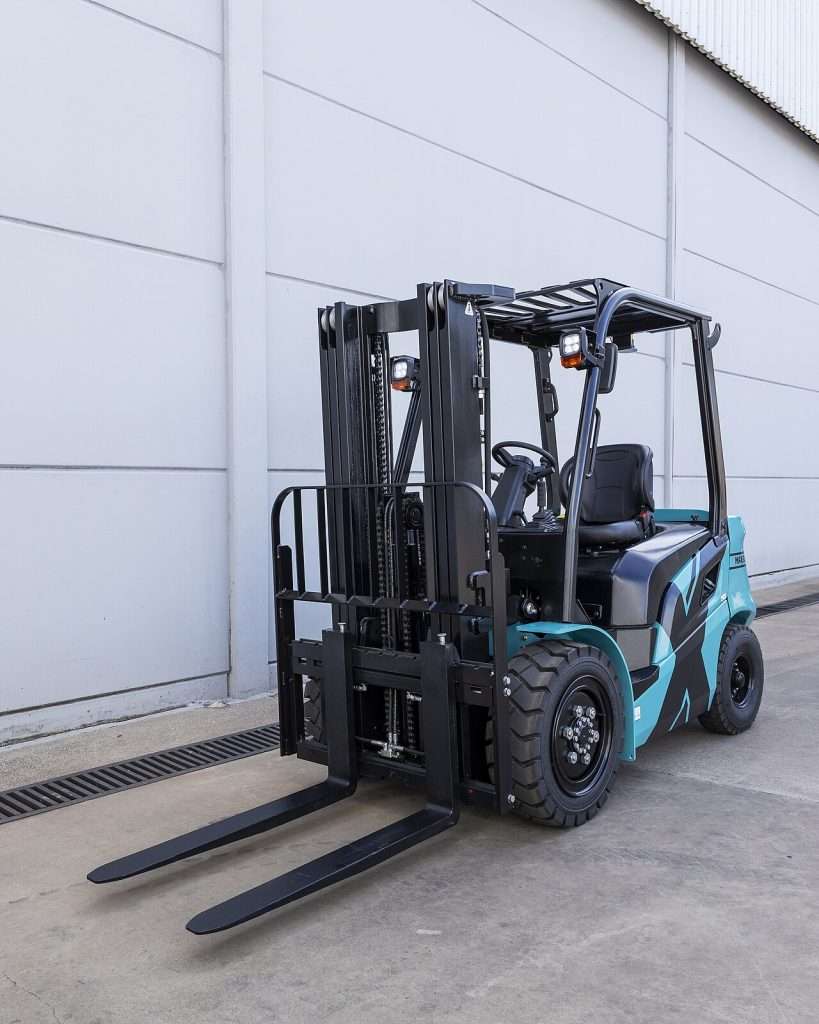
Short answer: choose an electric forklift for indoor work, clean environments and predictable shifts; choose diesel for heavy loads, rough yards and long outdoor shifts where refuelling must be fast; choose LPG when you need one truck that works both indoors (with ventilation) and outdoors and can refuel in minutes. For trucks bought from China, the right choice also depends on your local emission rules, your power supply and how easily you can service the engine or battery after delivery.
This guide is written for importers, dealers and end users comparing counterbalance forklifts from Chinese manufacturers. It explains the real differences between the three power types, the specifications you must fix in your RFQ, the red flags we see in Chinese quotations, and what to check before the trucks are loaded into a container. For a wider overview of the category, see our forklift and material handling equipment sourcing guide.
Electric vs diesel vs LPG forklifts at a glance
The table below summarises how the three power types typically compare. Exact figures vary by model and supplier, so treat it as a starting point and confirm details on each quotation.
| Factor | Electric (lead-acid or lithium) | Diesel | LPG / dual-fuel |
|---|---|---|---|
| Best environment | Indoor warehouses, food and cold stores, smooth floors | Outdoor yards, timber, steel, building materials, rough ground | Mixed indoor/outdoor work with good ventilation |
| Common capacity range | Typically 1.0–3.5 t, larger models exist | Typically 2–10 t and above | Typically 1.5–5 t |
| Exhaust emissions at point of use | None | Highest; needs aftertreatment on modern engines | Lower than diesel but not zero (CO risk indoors) |
| Refuel / recharge | Hours of charging; lithium allows opportunity charging | Minutes | Minutes (cylinder swap) |
| Purchase price | Usually highest, especially with lithium battery | Usually lower than electric | Often similar to or below diesel |
| Running and maintenance cost | Lowest energy cost, fewest moving parts | Fuel, filters, oil, aftertreatment | Fuel cost depends on local LPG price |
| Main import risks | Battery quality, charger voltage, dangerous-goods shipping for lithium | Engine emission compliance, engine brand and service network | Fuel system compliance with local gas rules |
How to choose the right power type
1. Start with the working environment
Where the truck works matters more than anything else. Indoor operations, especially food, pharmaceutical and cold storage, almost always point to electric trucks because they have no exhaust and run quietly. Outdoor yards with gravel, slopes, rain and long distances favour diesel trucks with pneumatic tyres and higher ground clearance. LPG is the compromise many distributors stock because one model can serve both, but LPG engines still produce carbon monoxide, so indoor use needs ventilation and regular emission checks.
2. Look at shift pattern and energy supply
A single 8-hour shift is easy for an electric truck with an overnight charge. Two or three shifts mean either a spare lead-acid battery and a battery change station, or a lithium battery that can be opportunity-charged during breaks. Diesel and LPG trucks can run around the clock with quick refuelling. Also check your site power: a large industrial charger may need a three-phase supply, and the charger input must match your local voltage and frequency. Our guide to voltage and frequency specifications for imported machinery explains how to state this correctly.
3. Check emission rules before you compare prices
This is where many first-time importers lose money. Diesel and LPG engines must meet the emission rules of the destination market. In the EU, engines in non-road mobile machinery fall under the Stage V regulation; in the USA, EPA Tier 4 Final applies to non-road diesel engines, and spark-ignition engines have their own rules. Many Chinese factories offer several engine options for the same truck: a domestic engine for markets with lighter rules, and an internationally branded or certified engine for regulated markets. The difference in price can be large, so always confirm which engine, which emission certificate and which aftertreatment (DPF, DOC, SCR) are included in the quote.
4. Think about service and parts for the next ten years
A forklift is a long-life asset. Ask who will service the engine or the battery. A widely used engine brand with local dealers is easier to support than an engine nobody in your country knows. For electric trucks, ask which controller, motor and battery cell suppliers are used, and whether the factory will supply parts lists with part numbers. See our machinery spare parts sourcing guide for how to plan a first spare parts kit.
Specifications that matter in your RFQ
Chinese quotations often look similar, but small specification differences change both price and suitability. Fix the following in writing:
- Rated capacity and load centre: capacity is quoted at a load centre, commonly 500 mm in China and Europe and 24 inches (about 610 mm) in North America. Compare trucks at the same load centre.
- Mast type and lift height: duplex, full free-lift duplex or triplex, with the maximum fork height you need. Residual capacity falls at higher lift heights, so ask for the load chart.
- Attachments: side shifter, fork positioner, rotator or clamps. Attachments reduce net capacity; ask the supplier to confirm the de-rated capacity.
- Tyres: pneumatic, solid (super-elastic) or press-on cushion tyres. Non-marking tyres may be needed in food and retail sites.
- Engine (diesel/LPG): brand, model, power, emission stage and certificate, and whether the truck is dual-fuel.
- Battery (electric): chemistry (lead-acid or lithium iron phosphate), voltage (for example 48 V or 80 V), capacity in Ah, cell brand, BMS brand and warranty terms.
- Charger: input voltage and frequency, plug type, charging time and whether it is onboard or separate.
- Safety equipment: overhead guard, seat belt and operator presence system, lights, reversing alarm, load backrest and any blue light or speed limit features you need.
- Documents: operator manual, parts book, wiring and hydraulic diagrams, and conformity documents for your market.
If you are writing a full specification for the first time, use our template on how to write a machinery RFQ.
Lead-acid vs lithium: the electric forklift decision
Most Chinese manufacturers now offer lithium iron phosphate (LiFePO4) batteries as an option or as standard. Lithium batteries usually cost more upfront but need no watering, can be charged during breaks and typically last more charge cycles. Lead-acid batteries are cheaper and simpler to ship, but need a charging area, regular maintenance and, for multi-shift work, spare batteries. When you compare quotes, ask for the cell brand, the BMS supplier, the rated cycle life and the battery warranty in writing. A lithium truck with an unnamed cell supplier and no cycle-life statement is not comparable with one that specifies both.
Common mistakes and red flags with Chinese forklift suppliers
- Capacity quoted at a short load centre or without a load chart, making a truck look stronger than a competitor’s.
- Engine swap after the order: the sample or brochure shows one engine, the production truck arrives with another. Write the engine brand and model into the contract.
- No emission certificate or a certificate that does not match the engine serial number. Without it, the truck may not be registered or used legally in your market.
- Battery capacity overstated or a lead-acid battery that is lighter than expected, which also affects counterweight and stability.
- Charger for the wrong voltage or with a plug that does not fit local sockets.
- Trading companies posing as factories, with no control over production. Check the supplier using our guide on how to verify a Chinese machinery supplier.
- Very low prices achieved with thinner chassis steel, cheaper mast chains, unbranded hydraulic components or reduced paint protection.
Pre-shipment inspection checklist
Inspect forklifts at the factory before balance payment. A practical checklist:
| Area | What to check | Applies to |
|---|---|---|
| Identity | Nameplate, serial number, engine/battery serial numbers match documents | All |
| Lifting test | Lift rated load to full height, hold, check mast drift and tilt drift | All |
| Hydraulics | No leaks at cylinders, hoses and valve; smooth lift, lower, tilt and side shift | All |
| Drive and brakes | Forward/reverse travel, service brake and parking brake on a slope if available | All |
| Engine | Cold start, idle, smoke, noise, oil leaks, emission label and certificate | Diesel, LPG |
| LPG system | Regulator, hoses and cylinder bracket; leak test with soapy water | LPG |
| Battery and charger | Voltage, capacity label, BMS display, full charge cycle, charger input voltage | Electric |
| Safety devices | Seat switch, horn, lights, reversing alarm, overhead guard, seat belt | All |
| Finish and documents | Paint, welds, decals in correct language, manuals, parts book, keys | All |
If you cannot travel, a remote video inspection can cover many of these points, and a formal factory acceptance test is worth it for larger orders.
Shipping, installation and spare parts
Forklifts are usually shipped in 20ft or 40ft containers, on flat racks for larger trucks, or by RoRo where routes allow. Small trucks can often be loaded whole; for container loading, the mast may be lowered or removed and the overhead guard may need to come off for height. Ask the supplier for a loading plan before you book freight; our export packing and container loading guide explains what to agree.
Lithium batteries are classified as dangerous goods for transport. Shippers typically need a UN38.3 test summary, a safety data sheet and correct dangerous-goods declarations, and some carriers apply surcharges or restrictions. LPG trucks are normally shipped without filled cylinders. Diesel trucks should be shipped with minimal fuel according to the carrier’s rules. Confirm all of this with your forwarder before production finishes.
On arrival, check the truck again before first use, fit the mast if it was removed, charge or fuel it, and run the full function test. Order a first spare parts kit with the trucks: filters, brake parts, mast chain wear parts, seals, fuses, relays and a spare set of keys are common items. Include the cost of freight, duties and parts in your landed cost calculation.
Frequently asked questions
Is an electric or diesel forklift better for a warehouse?
For enclosed warehouses, an electric forklift is usually the better choice because it produces no exhaust and is quieter. Diesel trucks are better suited to outdoor yards and heavy loads.
Can an LPG forklift be used indoors?
LPG trucks are used indoors in many markets, but they still emit carbon monoxide. Good ventilation, regular engine tuning and compliance with local workplace rules are required.
Are Chinese lithium forklift batteries reliable?
Quality varies widely. Ask for the cell brand, BMS supplier, cycle-life rating, warranty terms and a UN38.3 test report, and test a full charge and discharge cycle during inspection.
Do Chinese forklifts meet EU or US emission rules?
Some models do, typically with an engine certified for that market. Confirm the engine model and emission certificate in the contract rather than relying on a brochure.
How long does production usually take?
Standard models are often available within a few weeks, while custom specifications or certified engines can take longer. Confirm the lead time with the supplier for your exact configuration.
Source forklifts with Supbon Sourcing
Supbon Sourcing helps importers and dealers compare Chinese forklift manufacturers on the same specification, verify engines, batteries and certificates, and inspect trucks before shipment. Learn more about our construction and material handling machinery sourcing and custom industrial equipment sourcing services, and see our service fees.
Comparing forklift quotes from China? Contact us with your requirements and we will help you choose the right power type and supplier.