
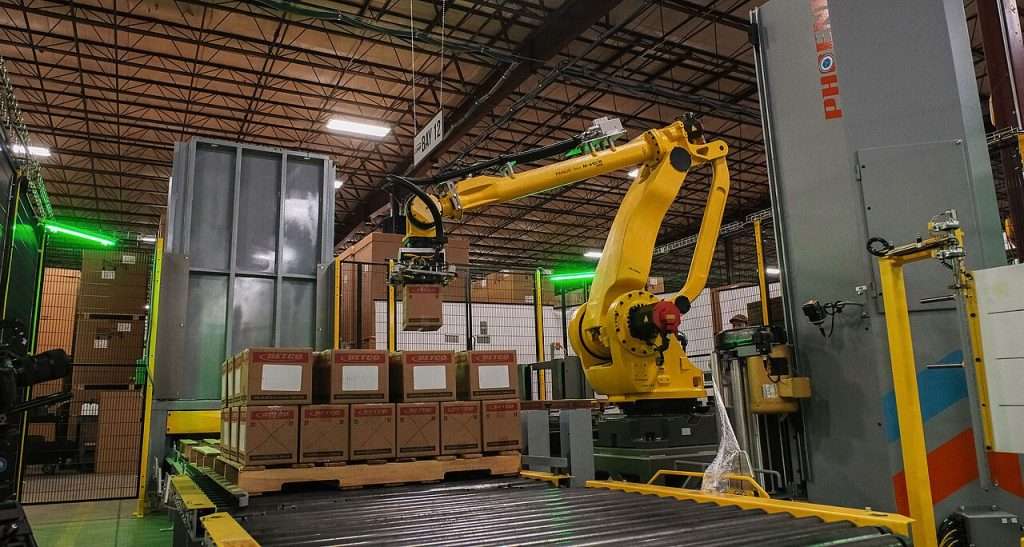
Palletizing is heavy, repetitive work and is one of the easiest places for a factory to start automating. China is now a strong supplier of palletizing robots, and many integrators build complete end-of-line systems around them, together with case packers, conveyors and stretch wrappers. This guide explains how to source palletizing robots and end-of-line automation from China.
1. Types of palletizing systems
- Robot palletizers: four-axis or six-axis arms, flexible and suitable for several products or pallet patterns.
- Collaborative robot palletizers: compact cells for low payloads and lower speeds. A risk assessment is still needed.
- Layer (gantry) palletizers: high-speed systems for uniform products such as cases or bags.
- Bag palletizers: for cement, feed, fertiliser and grain.
- End-of-line equipment: case erectors and packers, tape sealers, labellers, stretch wrappers, conveyors and pallet dispensers.
2. Information to give suppliers
- Product type, size and weight: cases, bags, drums or crates.
- Cycle rate in cases or bags per minute, now and in future.
- Pallet size, pallet pattern and stack height.
- Number of production lines feeding the system.
- Available floor space and ceiling height. A layout sketch helps.
- Interfaces with your existing machines, and power and air supply.
3. Key points to compare
- Robot: brand, payload, reach and repeatability. Payload must include the gripper as well as the product.
- Gripper: vacuum, clamp or fork type, matched to your product. Grippers cause many real-world problems, so test them carefully.
- Software: how easily operators can create new pallet patterns.
- Conveyors and infeed: product orientation, accumulation and jam handling.
- Controls: PLC and HMI brands, and communication with your line.
- Integrator’s experience: ask for reference projects with similar products.
See also our industrial robot and automation guide and conveyor system guide.
4. Safety and compliance
Robot cells need fencing or other safeguarding, light curtains at pallet exits, emergency stops and a risk assessment. In Europe, machinery rules apply to the complete system, including integration. Agree who is responsible for documentation and final safety checks. See CE marking for machinery from China.
5. Factory acceptance test
- Run the system with your real cases, bags or products. Send samples to China if needed.
- Measure real cycle rate over a sustained run.
- Build complete pallets, and check stability and pattern accuracy.
- Test changeovers, jam recovery and restart after an emergency stop.
- Check robot and component brands against the contract.
See our factory acceptance test guide.
6. Installation and support
Agree on engineers, on-site commissioning, operator training, remote support, spare parts and software backups. Choose a robot brand with local service if possible. See warranty and after-sales service and shipping machinery from China.
Frequently asked questions
Robot or conventional palletizer?
Robots suit lower to medium speeds and frequent product changes. Conventional layer palletizers suit high-speed, uniform lines.
Can one robot serve two lines?
Often yes, if the layout and cycle rates allow it. Ask the integrator for a cycle time simulation.
Can you source a complete packing line?
Yes. See packaging machines and filling lines.
Source end-of-line automation with Supbon Sourcing
Supbon Sourcing helps factories compare Chinese robot integrators, review layouts, witness tests with real products and manage shipping. Learn more about our industrial automation equipment sourcing service.
Planning to automate palletizing? Send us your product and line details for a quote.