
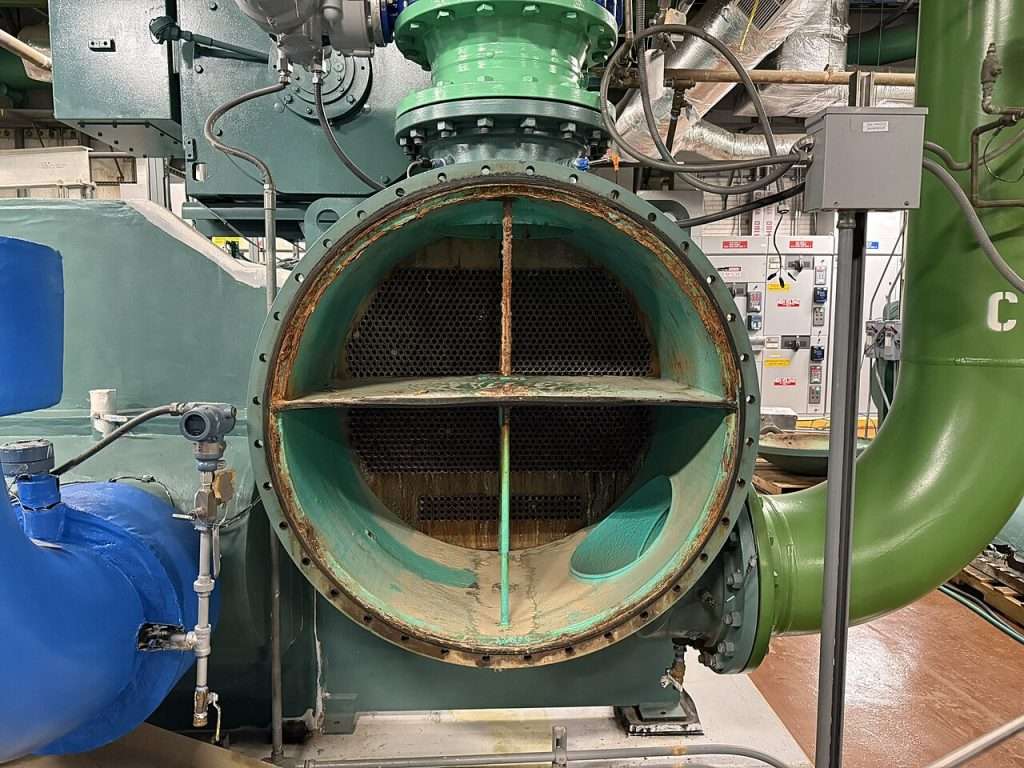
Industrial chillers keep plastics machines, lasers, CNC spindles, food lines, chemical reactors and many other processes at a stable temperature. When a chiller fails or is undersized, the machine it supports often stops or produces scrap. China has a large refrigeration industry that makes both compact units and large screw chillers. This guide explains how to select and verify chillers as part of machinery sourcing in China, so that the rated capacity matches what you actually receive.
Types of industrial chillers
- Air-cooled chillers: reject heat to ambient air. They are simple to install and need no cooling tower, but are sensitive to high ambient temperature.
- Water-cooled chillers: reject heat to a cooling tower or other water source. They are often more efficient but require more site infrastructure and water treatment.
- Scroll chillers: common at small and medium capacity.
- Screw chillers: widely used at larger capacity and in continuous duty.
- Low-temperature and glycol chillers: for processes below normal chilled water temperature.
- Laser and spindle chillers: compact units with close temperature stability, often supplied with the host machine.
What to specify before asking for quotes
Rated capacity means little without its operating conditions. Your technical specification should state:
- Cooling load in kW, and how it was calculated, including a margin agreed with your engineer.
- Supply and return fluid temperatures and required stability.
- Fluid type, including glycol percentage if any, since glycol reduces capacity.
- Flow rate and pressure needed at the process.
- Maximum ambient temperature on site, and altitude if significant.
- Power supply: voltage, phase and frequency. A unit built for 50 Hz cannot simply be run on 60 Hz.
- Refrigerant restrictions in your country.
- Indoor or outdoor installation, and noise limits.
- Control interface, such as Modbus, remote start and alarm outputs.
Key quality points
- Compressor: name the brand and model in the contract and check the nameplate at inspection. Compressor substitution is a known risk across the industry.
- Capacity at your conditions: ask for a selection sheet calculated at your actual water temperatures and ambient, rather than a brochure condition.
- Heat exchangers: confirm the evaporator and condenser type, material and fouling allowance. Shell-and-tube units are easier to clean than brazed plates on dirty water.
- Pump and tank: if included, check pump duty, tank material and insulation.
- Refrigeration controls: expansion valve type, pressure switches, oil protection and anti-freeze protection.
- Corrosion resistance: for coastal or humid sites, ask about coil coating and enclosure paint.
- Electrical cabinet: check the brand of contactors, overload protection, wiring quality and cabinet cooling.
Safety and compliance
Chillers combine refrigerant pressure, electricity and rotating equipment. For the EU, check CE marking, the Pressure Equipment Directive, and F-gas rules that restrict certain high-GWP refrigerants. In the United States, pressure vessels may need ASME certification, and in other markets local pressure vessel or electrical approvals may apply. Refrigerant handling usually requires qualified local technicians. Never accept a general certificate without confirming that it covers the exact model and configuration you are buying.
Sizing mistakes to avoid
Many chiller problems come from the selection stage rather than from the factory. Common mistakes include:
- Quoting the capacity of the host machine’s motor instead of the actual heat load.
- Selecting at a mild ambient temperature when the site has hot summers.
- Ignoring pressure drop in long pipe runs, so the pump cannot deliver the needed flow.
- Forgetting the buffer tank volume on processes with rapid load changes.
- Treating one chiller as enough where a stoppage would halt production, instead of considering a standby unit.
Testing before shipment
Ask for a load test rather than just a power-on check. A good factory acceptance test for a chiller includes:
- Running under load at or near the design water temperatures, recording capacity, power draw and stability.
- Checking refrigerant pressure, superheat and subcooling.
- Testing high and low pressure cut-outs, flow switch and freeze protection.
- Leak testing the refrigerant circuit and water side.
- Checking nameplate data against the contract: compressor, refrigerant, voltage.
- Noise and vibration review.
- Checking the controller, alarms, communication interface and manual.
Shipping and spares
Most packaged chillers travel with refrigerant charged or nitrogen-held, and rules for refrigerant-charged equipment should be confirmed with your forwarder. Protect coils from impact and secure units properly in the container, following our guide to shipping machinery from China. Keep filter driers, sensors, contactors, fan motors, water filters and pump seals in stock. Review our advice on machinery spare parts sourcing when building the list. Local refrigeration support is essential, so check that the refrigerant and components chosen can be serviced in your country.
Frequently asked questions
Should I choose an air-cooled or water-cooled chiller?
Air-cooled units suit sites without a cooling tower or with limited water. Water-cooled units often suit larger loads where tower water is available. The best option depends on climate, water cost and maintenance capacity.
How much margin should I add to the cooling load?
There is no single figure. It depends on how accurately the load is known, future expansion and climate. Have an engineer review the calculation rather than oversizing heavily, which can cause short cycling.
Can a chiller be bought together with my main machine?
Yes, and it is common for injection molding or laser equipment. Ask for the chiller specification separately, because the unit bundled with a machine may be sized for mild conditions. If you are still selecting the molding machine itself, our guide on injection molding machine tonnage and shot size explains how to size it first.
Source industrial chillers with Supbon Sourcing
Supbon Sourcing, based in Jinan, Shandong, helps overseas buyers identify manufacturers, clarify technical details and check equipment before it ships. Chillers are often purchased alongside injection molding machines or compressed air systems. Contact us with your cooling load, fluid temperatures and site conditions.